

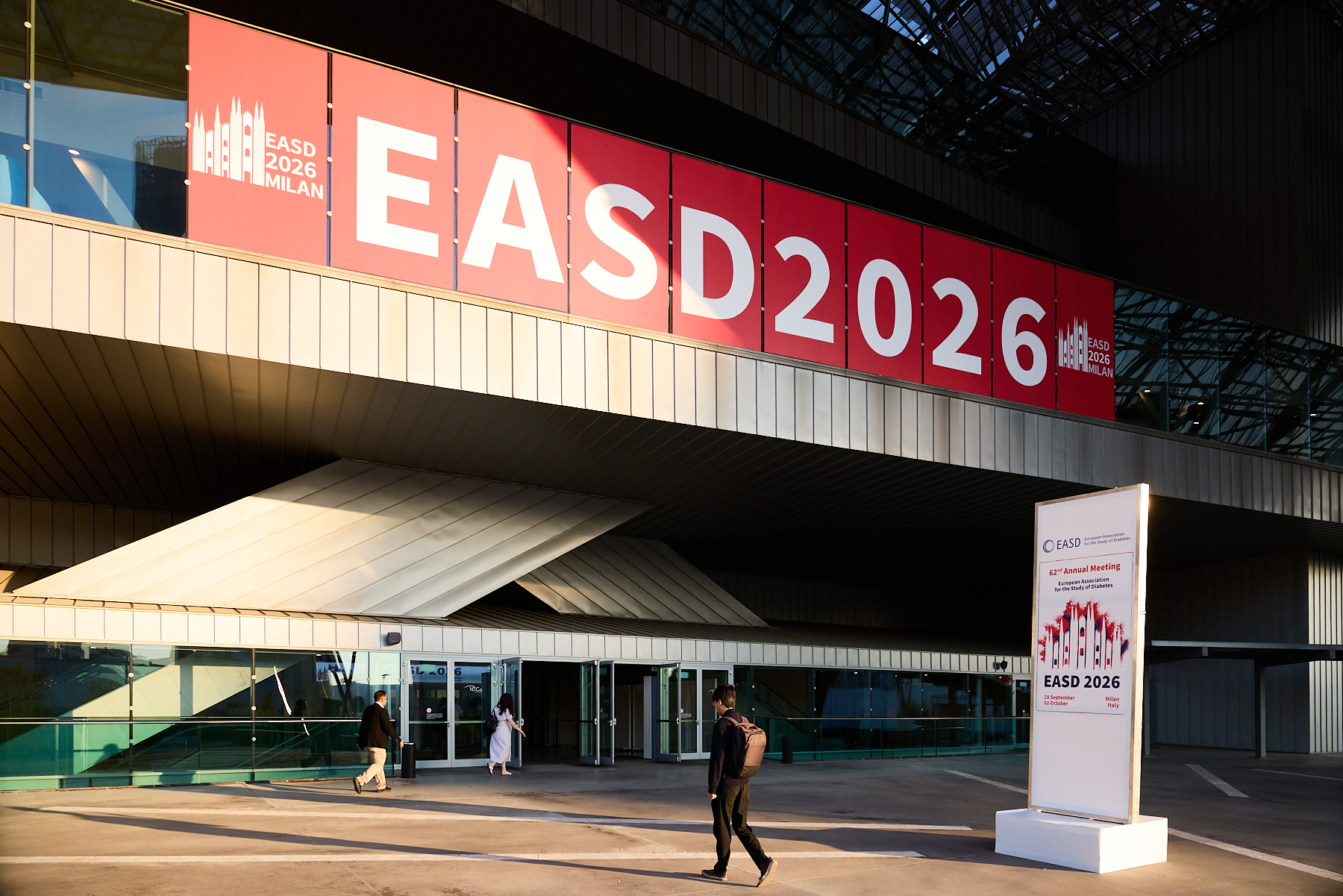
The 62nd Annual Meeting of the European Association for the Study of Diabetes (EASD), one of the world’s largest congresses in diabetes research, takes place in Milan from September 28 to October 2, 2026. Once again this year, the German Diabetes Center (DDZ) is represented on site by numerous scientists and contributes to the scientific program with seven invited lectures and seven short talks. In eleven further sessions, DDZ researchers will act as chairs.
Diabetes and its complications will be examined from many angles by DDZ researchers at the EASD Annual Meeting in Milan. A particular focus is on contributions addressing fatty liver disease (MASLD) and its inflammatory form, MASH. Prof. Michael Roden, Scientific Director and Spokesman for the Board of the DDZ as well as Director of the Department of Endocrinology and Diabetology at Düsseldorf University Hospital, presents fatty liver disease as a condition with effects reaching far beyond the liver and discusses the translation of newly approved MASH therapies into clinical practice.

Another lecture addresses the role of weight loss in the treatment of MASLD and showes, based on clinical and mechanistic study data, that glucose-lowering drugs such as GLP-1 receptor agonists and SGLT2 inhibitors have effects that go beyond weight reduction alone. These contributions are complemented by a short talk based on new data from the German Diabetes Study, presenting an analysis of how body fat percentage and fat-free mass affect liver fat content and insulin sensitivity in people with newly diagnosed type 2 diabetes.
Inflammation and Environmental Factors as Risk Drivers
Two further contributions focus on inflammatory processes and environmental influences as risk factors for type 2 diabetes and its complications. Data from the German Diabetes Study show that diabetes-related complications may in some cases already be present at the time of diagnosis. A lecture on inflammation as a prognostic factor for type 2 diabetes and its complications shows that inflammatory biomarkers can improve risk prediction, though so far only to a small or moderate extent. The available data are not yet sufficient for clinical use. Looking ahead, a key question in precision medicine is whether such biomarkers could be used in the future to identify individuals who might benefit particularly from anti-inflammatory treatment approaches – a question the DDZ is researching intensively.
Another short talk addresses the topic of air pollution. It presents a recent DDZ study that investigated how long-term exposure to air pollutants is associated with body fat distribution in people with type 2 and type 1 diabetes.
Photos whose image rights belong to the DDZ may be used for editorial purposes with the credit: “Deutsches Diabetes-Zentrum”. The reproduction is royalty-free. Stock photos may not be reused for licensing reasons. We would appreciate it if you could send us a proof copy or let us know where the material will be published.
Contact person at the DDZ for further questions is: