
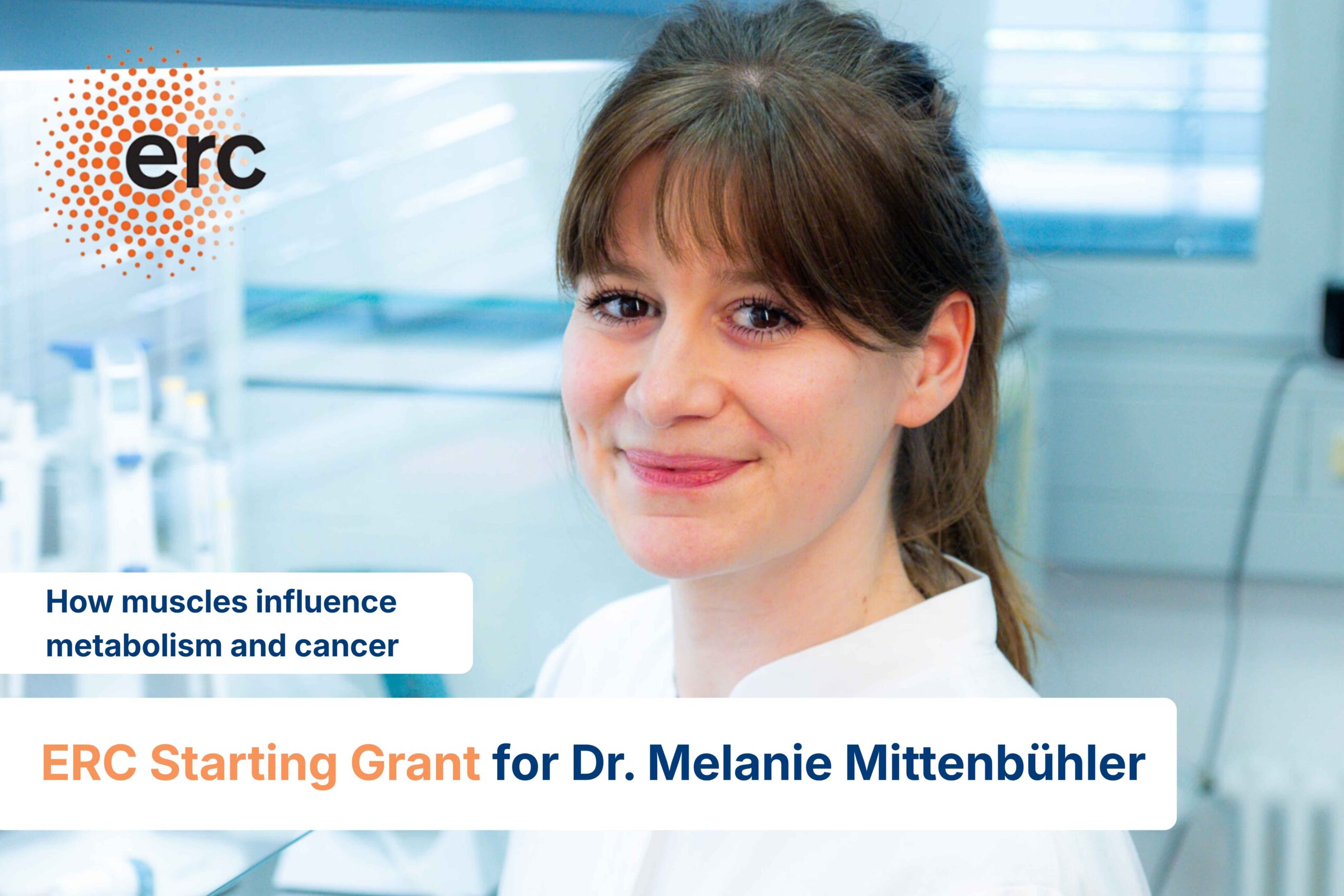
How does skeletal muscle influence metabolism and the development of cancer through the body’s own messenger molecules? This is the question Dr. Melanie Mittenbühler, head of the Junior Research Group Crosstalk at the German Diabetes Center, will investigate over the next five years as part of the MYOSCAN project. She receives a European Research Council (ERC) grant worth €1.7 million to support the project. The ERC Starting Grant is one of Europe’s most prestigious and competitive funding schemes for outstanding early-career researchers.
Regular exercise protects muscle tissue and is associated with a lower risk of cancer; an effect that becomes increasingly important with age, when the risks of type 2 diabetes, cancer, and sarcopenia (the age-related loss of muscle mass and strength) rise in parallel. In an aging population increasingly affected by insulin resistance, sarcopenia can lead to frailty, loss of independence, and an increased risk of mortality. However, how exercise protects muscle tissue while also reducing cancer risk remains poorly understood at the molecular level.
Myokines: How muscles communicate with the body
This is where skeletal muscle comes in. Far more than an organ of movement, skeletal muscle is an endocrine organ that lies at the heart of MYOSCAN. It communicates with other organs through messenger molecules known as myokines, thereby influencing metabolism, immune function, inflammation and numerous other processes throughout the body. Exercise alters the release of these messengers and thereby contributes to their health-promoting effects. Conversely, as muscle mass and function decline, this communication becomes dysregulated. It is suspected that weakened muscle releases signals that promote chronic inflammation, which may in turn contribute to the development of cancer.
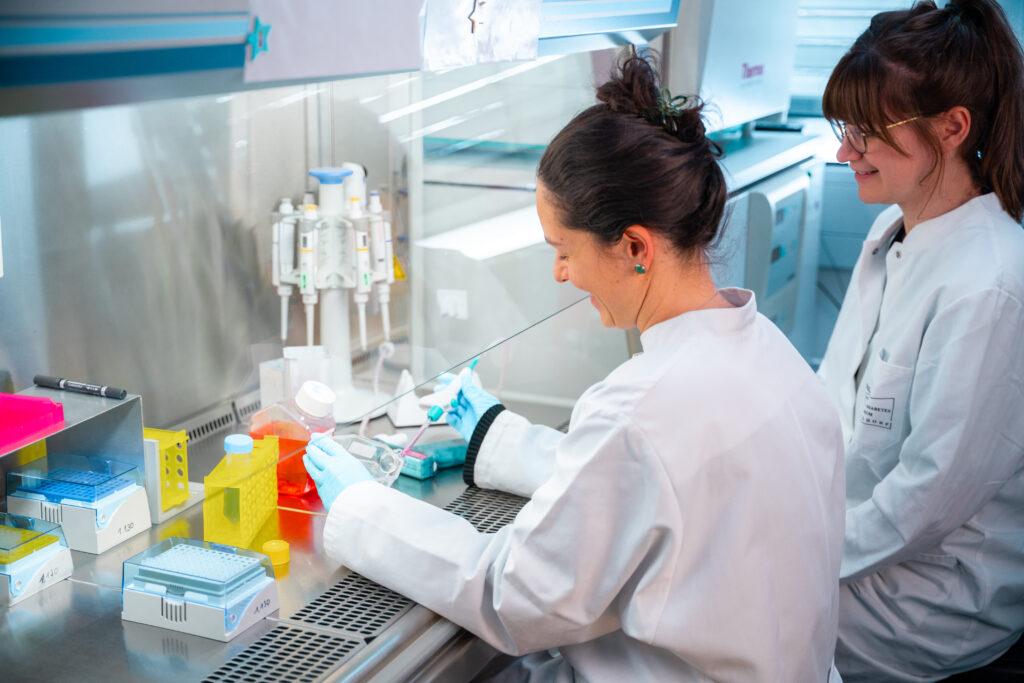
“This is precisely where MYOSCAN begins. We are systematically investigating which myokines skeletal muscle releases in response to exercise and age-related muscle loss,” explains Dr. Melanie Mittenbühler, head of the Junior Research Group Crosstalk at the German Diabetes Center (DDZ). 4,807 researchers applied for an ERC Starting Grant in this funding round, but only around one in every 11 applicants will receive funding from the European Research Council in this period. With the grant, Melanie Mittenbühler will be able to expand her research group by three new team members.
MYOSCAN could also be highly relevant in the context of GLP-1 medications
For their investigations, the team uses a state-of-the-art approach to analyze the extracellular fluids of skeletal muscle. “This enables us to determine which proteins are released by trained and therefore healthy muscle compared with muscle weakened by age. Our aim is to identify new myokines, particularly those that promote or inhibit cancer growth,” says Mittenbühler. While it is well established that cancer can cause muscle wasting, a condition known as cachexia, it remains unclear whether sarcopenic muscle can, conversely, promote the development of cancer.
The research project is of central importance for diabetes research, emphasizes Prof. Michael Roden, Scientific Director and Spokesman of the Board of the DDZ as well as Director of the Department of Endocrinology and Diabetology at University Hospital Düsseldorf. “Skeletal muscle plays a key role in glucose metabolism. Insights into how muscle cells communicate with other organs can provide new starting points for the prevention and treatment of diabetes and other age-related diseases. The ERC Starting Grant emphasizes the scientific relevance of Dr. Melanie Mittenbühler’s research.”
MYOSCAN could also be highly relevant in the context of so-called weight-loss injections: GLP-1 medications improve blood glucose control and promote weight loss, but they may also be accompanied by a reduction in muscle mass; an effect that is particularly difficult to reverse in older patients. Whether this muscle loss, combined with sarcopenia, further promotes cancer risk remains unknown.
About the ERC Starting Grant
The ERC Starting Grant supports talented early-career researchers following their doctorate and is among Europe’s most prestigious and highly competitive funding programs. Through it, the European Research Council supports excellent frontier research with high potential for significant scientific discoveries.
Photos whose image rights belong to the DDZ may be used for editorial purposes with the credit: “Deutsches Diabetes-Zentrum”. The reproduction is royalty-free. Stock photos may not be reused for licensing reasons. We would appreciate it if you could send us a proof copy or let us know where the material will be published.
Contact person at the DDZ for further questions is: