

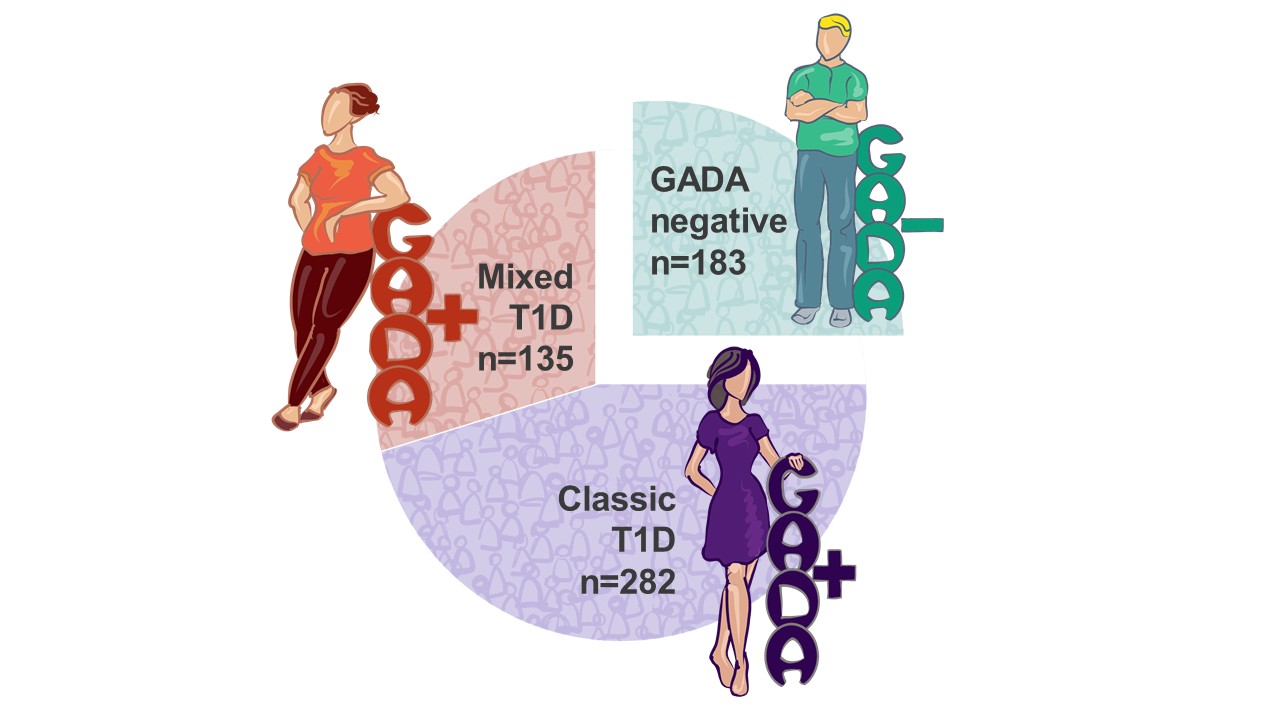
Adults who develop diabetes often have type 2 diabetes, but not always. Type 1 diabetes can also begin in adulthood. Researchers from the German Diabetes Center (DDZ), University Hospital Düsseldorf and University Hospital Tübingen have now identified three subgroups among adults. Particularly notable is the “mixed” type 1 diabetes: it combines features of type 1 and type 2 diabetes but apparently arises from the same autoimmune reaction as classic type 1 diabetes and is diagnosed at an earlier stage. This could open up new possibilities for protecting the remaining insulin-producing cells with novel therapies.
Many people know type 1 diabetes as an autoimmune disease that occurs in childhood and adolescence, in which the immune system attacks the insulin-producing beta cells of the pancreas. However, like type 2 diabetes, type 1 diabetes is not a uniform disease and can first appear in adulthood. The rate at which insulin production declines, and how much endogenous insulin is still present at diagnosis, differ considerably. This is why distinguishing it from type 2 diabetes is not always straightforward.
To better understand which different forms of type 1 diabetes occur in adults, the researchers analyzed data from 600 adults in the German Diabetes Study (GDS) whose diabetes had been diagnosed less than one year earlier. Based on five laboratory parameters, including antibodies and C-peptide (which indicates how much insulin the body still produces itself), a statistical method (cluster analysis) formed three groups. A second, independent dataset of 483 adults with type 1 diabetes showed a similar group structure.
The analysis revealed three groups with distinct characteristics. In classic type 1 diabetes, affected individuals were on average 34 years old, rather lean, sensitive to insulin, and produced only little endogenous insulin at diagnosis. In mixed type 1 diabetes, they were older, at an average of 41 years, had a higher body weight, were less sensitive to insulin (greater insulin resistance), and still produced considerably more endogenous insulin at diagnosis. Both groups had GAD antibodies (antibodies against glutamic acid decarboxylase), an indicator of an autoimmune reaction.
Classic and mixed type: the same autoimmune process at different stages
The classic and the mixed type differ neither in their antibodies nor in their genetic risk for type 1 diabetes. This suggests the same autoimmune process, appearing at different stages. One can think of it as a marathon: at diagnosis, the mixed type is only at kilometer 20, while the classic type is already at kilometer 40. In terms of time, roughly six years lie between the two stages. “This does not mean that the mixed type is diagnosed six years earlier, but that type 1 diabetes is less advanced at the time of diagnosis,” explains Dr. Katsiaryna Prystupa, a scientist at the DDZ and physician in the Department of Endocrinology and Diabetology at University Hospital Düsseldorf.
“What we learn from this is that we need to look more closely at the heterogeneity of type 1 diabetes in adults as well. Whether knowledge of a mixed type will also lead to more precise treatment remains to be seen,” says Prof. Michael Roden, Scientific Director and Spokesperson of the Board of the DDZ and Director of the Department of Endocrinology and Diabetology at Düsseldorf University Hospital.
Implications for diagnosis and first indications of differences in complications
For diagnosis, this means: “Especially in adults, we should pay greater attention not only to insulin deficiency but also to residual endogenous insulin production and the sensitivity of the body’s cells to insulin. Individually tailored insulin therapy and regular screening examinations remain crucial,” says Prof. Robert Wagner, Head of the Clinical Study Center at the DDZ and Senior Physician at University Hospital Düsseldorf. The researchers also compared how frequently diabetes-related complications occurred in the groups. “After adjusting for age, sex, body weight, blood pressure and smoking, there were indications that people with mixed type 1 diabetes more frequently develop retinal damage (retinopathy) than people with the classic type. This needs to be confirmed in larger studies,” says Prof. Andreas Fritsche, Head of the Department of Diabetes Prevention and Therapy at University Hospital Tübingen.
Third group: autoimmune diabetes or other forms of insulin-deficient diabetes
The third group, without antibodies, is also important for research. It could include autoimmune diabetes, but also other forms of insulin-deficient diabetes. Because antibody detection plays a major role in diagnosing type 1 diabetes, there is a risk that these individuals are wrongly classified as having type 2 diabetes and receive insulin therapy late. “Here we need to monitor closely whether these individuals become insulin-dependent over time,” Wagner emphasizes.
Original Publication:
Titel: Clinical and metabolic subtypes of recent-onset adult type 1 diabetes: a prospective cohort study
Authors: Prystupa, K., Fritsche, A., Binsch, C. et al.
Journal: Lancet Diabetology and Endocrinology
Doi: www.doi.org/10.1016/S2213-8587(26)00233-0
Photos whose image rights belong to the DDZ may be used for editorial purposes with the credit: “Deutsches Diabetes-Zentrum”. The reproduction is royalty-free. Stock photos may not be reused for licensing reasons. We would appreciate it if you could send us a proof copy or let us know where the material will be published.
Contact person at the DDZ for further questions is: